SELECT AN ARTIFACT
The Artifact Archive
Choose an artifact from the collection index to open its archive record.
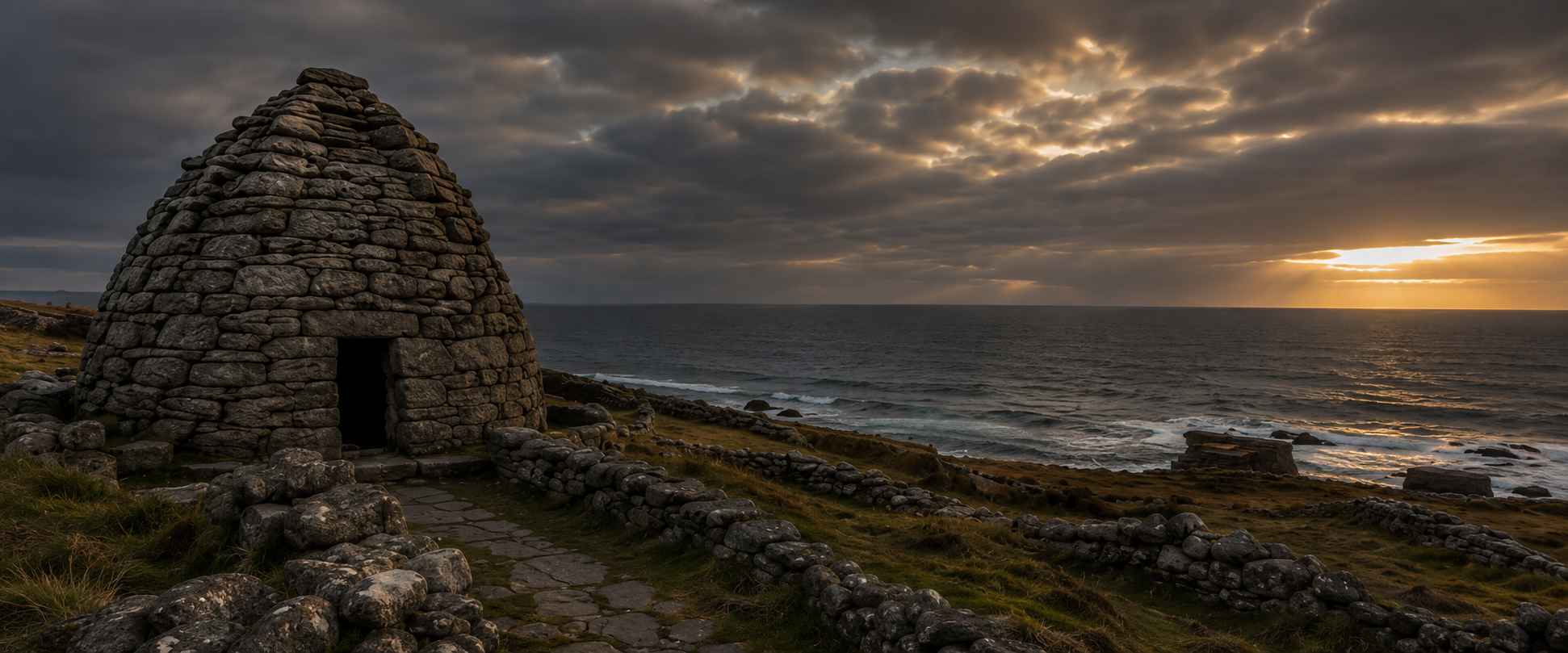
Return to Artifact IndexThe Brandon House
The Moche-Irish Manuscript
Fictional ArtifactDiscovered beside the ancient mariner beneath the Brandon House, the manuscript provides the first written connection between early Irish voyagers and the Moche civilization of Peru.
- Appears in
- The Brandon House
- Cultural connection
- Early Irish Christian and Moche
- Material
- Vellum, pigments and binding
- Story location
- Beneath the Brandon House
- Historical status
- Fictional
Why It Matters
A written record that changes the investigation
The manuscript turns an extraordinary burial into evidence of a much larger journey. Its imagery and translated account connect the discovery in Dingle with the Moche world of Peru, directing George and Jazz toward the next stage of their search.
Within the Story
The manuscript is discovered beneath the remains of the original farmhouse, wrapped in a protective covering and placed beside an ancient mariner. George immediately recognizes that the burial is unusual, but it is Jazz who identifies the impossible combination of early Irish and Moche influences.
Once translated, the manuscript records the journey of the Fior-Chocair and points towards an ancient temple in Peru. What begins as a discovery beneath the Brandon House becomes a map into a forgotten chapter of transatlantic history..
History Behind the Fiction
Medieval Irish monasteries produced richly decorated manuscripts on vellum, preserving religious texts, genealogies and historical traditions. The Moche civilization of northern Peru left no known written language comparable to an Irish manuscript, but recorded beliefs and events through ceramics, metalwork, murals and complex visual imagery.
The manuscript is fictional. Its mixture of written Irish tradition and Moche symbolism imagines how two cultures might have created a shared historical record..
Creating the Artifact
I needed an object capable of connecting a burial in Ireland with a mystery in Peru. A manuscript allowed the discovery to contain more than physical evidence. It could preserve a voice, a journey and directions left for whoever eventually uncovered it.
I combined the manuscript traditions of early Christian Ireland with Moche visual storytelling. The undeciphered writing, layered symbols and incomplete translation gave George and Jazz enough information to begin their search without revealing everything at once.
From the Book
Contains possible story spoilers.
George finds the manuscript beside the ancient mariner beneath the farmhouse. He and Áine secure it with the other objects before Jazz arrives to examine the discovery. Photographs are later analyzed with Irene’s assistance, revealing a record of the Fior-Chocair, a transported treasure and a journey into the Peruvian Andes.
The translated landmarks eventually lead George and Jazz towards Colca Canyon and the hidden community safeguarding the manuscript’s legacy.
The Brandon House
The Celtic-Moche Grave Goods
Inspired by HistoryGold, silver and ceremonial objects whose blended designs provide physical evidence connecting two distant cultural traditions.
- Appears in
- The Brandon House
- Connection
- Early Irish Christian and Moche
- Material
- Gold, silver and ceramic
- Status
- Fictional, historically inspired
Within the Story
The gold and silver objects are discovered beside the ancient mariner and the manuscript. Their markings combine forms Jazz associates with early Irish Christianity and symbols that appear to be Moche in origin.
The grave goods provide the investigation’s first physical evidence that the cultural connection described by the manuscript may be genuine within the novel. Their value also attracts unwanted attention, turning an archaeological discovery into something far more dangerous.
History Behind the Fiction
Grave goods are objects deliberately placed with human remains during burial. They may reflect status, belief, identity or the expectation that the deceased would require certain possessions after death.
The Moche were accomplished metalworkers who created elaborate objects from gold, silver and copper. Early Christian Ireland also developed a distinctive metalworking tradition featuring interlace, sacred imagery and detailed ornamentation. The combined Celtic-Moche designs in the novel are fictional, but the craftsmanship behind them draws upon both traditions.
Creating the Artifact
I wanted the first evidence of contact to be visible before anyone could translate the manuscript. The grave goods therefore had to look wrong in a very specific way: recognizably connected to two cultures that conventional history places on opposite sides of the Atlantic.
Rather than inventing a single famous treasure, I treated them as a burial collection. Their jewellery, precious metals and blended symbols show that the meeting of the cultures produced something new.
From the Book
Contains story details and possible spoilers.
George discovers gold and silver trinkets arranged beside the ancient mariner. Jazz initially examines photographs and identifies markings resembling both early Christian and Moche designs. The objects are secured in Áine’s surf lockers, but an attempt to recover them reveals that someone else already understands their importance.
Later examination confirms that the grave goods are connected to the people and journey described in the manuscript.
The Brandon House
The Gilded Reliquary
Fictional ArtifactA chamber object joining Christian imagery, Moche beliefs and traditions of Viracocha.
- Appears in
- The Brandon House
- Story location
- Peru
- Historical status
- Fictional
Within the Story
The reliquary is encountered inside the sacred chamber protected by the descendants of the manuscript’s people. Its engravings combine Christian imagery with stories connected to Viracocha and the community’s ancestral beliefs.
For Jazz, it demonstrates that the meeting of cultures was not a brief encounter. Their beliefs, artistic traditions and histories had continued to develop together across generations.
History Behind the Fiction
A reliquary is a container created to preserve sacred remains or objects. Medieval Irish reliquaries were often made from wood covered with decorative metal plates, precious materials and Christian imagery.
The novel combines this tradition with Andean religious symbolism. Viracocha belongs primarily to later Inca traditions rather than to the earlier Moche civilization. The reliquary’s blended beliefs are therefore part of the fictional culture that developed over centuries within the story.
Creating the Artifact
The hidden chamber needed an object that expressed the spiritual result of the cultural connection. Gold alone would suggest treasure. A reliquary suggests memory, belief and preservation.
I imagined an object created by descendants who no longer saw Irish Christianity and Andean tradition as separate systems. Its engravings show how inherited stories could be adapted until they formed one shared tradition.
From the Book
Contains story details and possible spoilers.
While the group documents the chamber, Jazz examines a gilded reliquary covered in delicate engravings. He recognizes Christian influences intertwined with the community’s interpretation of Viracocha and its ancestral beliefs.
His respectful treatment of the object helps the caretakers understand that the expedition has not come simply in search of gold. The moment contributes to the trust that gradually forms between the two groups.
The Brandon House
The Caretakers’ Stone Pendants
Fictional ArtifactCarved gifts symbolizing trust, shared history and responsibility for the chamber’s legacy.
- Appears in
- The Brandon House
- Material
- Carved stone
- Historical status
- Fictional
Within the Story
The stone pendants are presented to George, Jazz and the other expedition members by the elders protecting the hidden chamber. Each is carved with symbols representing celestial bodies and flowing rivers.
They are not taken as archaeological prizes. They are freely given as expressions of trust, recognizing the visitors as people who now share responsibility for protecting the community’s history.
History Behind the Fiction
Pendants and amulets have been used by cultures around the world to express identity, belief, status and protection. Andean imagery frequently drew upon the sun, moon, water, mountains and other forces shaping agricultural and spiritual life.
The exact pendants and their ceremony are fictional. Their meaning draws upon the genuine importance of reciprocity, custodianship and the transfer of knowledge between generations.
Creating the Artifact
I wanted the expedition to leave with something more meaningful than recovered treasure. The pendants allowed the caretakers to decide what could be given and what needed to remain protected.
Their stone construction contrasts with the gold objects in the chamber. Their importance comes from the people who present them and the responsibility they represent, not from their financial value.
From the Book
Contains story details and possible spoilers.
After the explorers demonstrate respect for the chamber and its contents, an elder approaches Jazz and offers him a carved stone pendant. Similar pendants are then presented to the other members of the expedition.
Although the two groups cannot fully communicate through language, the exchange makes their understanding clear. The visitors are being trusted to carry the story beyond the chamber without betraying the people who preserved it.
The Atlantis Enigma
The Aetherion Crystal
Fictional ArtifactThe luminous heart of the Atlantean mystery and the object sought beneath the Aran Islands.
- Appears in
- The Atlantis Enigma
- Story location
- Aran Islands
- Historical status
- Fictional
Within the Story
The Aetherion Crystal is presented as the heart of Atlantean knowledge and the source of both the civilization’s achievements and its destruction. Hidden before the fall of Atlantis, it is eventually located beneath the waters surrounding the Aran Islands.
The crystal becomes the central objective of the investigation. George and his companions must determine whether it represents preserved knowledge, an uncontrollable source of power or a warning that was never meant to be ignored.
History Behind the Fiction
Atlantis originates in Plato’s dialogues Timaeus and Critias. Plato described a powerful island civilization destroyed after it became corrupt, but he did not mention an Aetherion Crystal.
Crystals have held ceremonial, decorative and symbolic importance in many cultures, but there is no archaeological evidence of an Atlantean energy source. The crystal and its abilities are entirely fictional, built around Atlantis as a warning about power, pride and human ambition.
Creating the Artifact
I wanted the central artifact to represent the contradiction at the heart of Atlantis: extraordinary knowledge paired with the arrogance to use it without understanding the consequences.
The crystal therefore contains both promise and danger. Different characters see it as knowledge, power, proof or a weapon. That uncertainty allows the artifact to reveal the motives of the people pursuing it.
From the Book
Contains significant spoilers.
The crystal is first described in the final days of Atlantis, when it is removed from the Grand Chamber and hidden in the western reaches of the civilization. Thousands of years later, George, Áine, Jazz and Irene find it resting upon a submerged stone altar.
Its recovery leads them to another chamber where the Order attempts to activate its power. The resulting instability forces the group to choose between preserving the discovery and preventing it from being used.
The Atlantis Enigma
The Carved Atlantean Stone Relic
Fictional ArtifactAn original stone object whose swirling script separates the discovery from the earlier replicas.
- Appears in
- The Atlantis Enigma
- Material
- Carved stone
- Historical status
- Fictional
Within the Story
The stone relic is uncovered after the group follows symbols from a replica into a hidden passage at Dún Aonghasa. Beneath accumulated sand and debris, Jazz reveals carvings matching the markings that first drew them into the investigation.
Unlike the replicas, this object appears to be genuinely ancient within the novel. It provides the first physical indication that the mysterious symbols belong to a larger system and may be connected to a lost Atlantean presence.
History Behind the Fiction
Carved stones, inscriptions and petroglyphs are among the most enduring forms of human communication. Their interpretation depends upon context, comparison and a clear archaeological record.
No verified Atlantean artifact or written Atlantean language has ever been discovered. The symbols on the relic are fictional. Their design draws upon the visual character of ancient geometric carvings without claiming to reproduce a genuine historical script.
Creating the Artifact
The investigation needed a moment when the mystery moved from reproduction to possible physical evidence. The stone relic provides that turning point.
I designed the markings as a language George and the others could recognize but not immediately understand. The repeated symbols connect the conference, the replicas, Dún Aonghasa and the hidden chambers while preserving uncertainty about their purpose.
From the Book
Contains story details and possible spoilers.
After Irene notices a faint symbol carved into a wall at Dún Aonghasa, the group discovers a concealed mechanism and passage. Inside, Jazz clears debris from a stone surface and exposes a series of intricate carvings.
The symbols match those found on the replicas, but this time they are part of the archaeological setting. Jazz believes they may represent an unknown Atlantean script and records the discovery for further analysis.
The Atlantis Enigma
The Atlantean Artifact Replicas
Story EvidenceCopies deliberately placed as messages, drawing the investigators toward the original relic.
- Appears in
- The Atlantis Enigma
- Classification
- Story evidence
- Historical status
- Fictional
Within the Story
The replicas appear as deliberate messages. One is found in Professor Turner’s office, while another is delivered to Jazz at the archaeological conference in Lahinch.
Because they are modern reproductions, they possess no archaeological value on their own. Their importance comes from their source, their identical symbols and the fact that someone wants investigators to recognize the object without revealing the location of the original.
History Behind the Fiction
Archaeological replicas are used for education, research, reconstruction and museum display. Modern 3D scanning and printing can reproduce the form of an object with remarkable precision while protecting the original.
A replica without provenance cannot prove that an ancient object exists. It can, however, preserve details known only to someone who has seen or recorded the original. This difference between authenticity and information is central to the role of the replicas in the novel.
Creating the Artifact
I liked the idea of beginning with an artifact that was openly acknowledged to be false. The question was not whether the replica was ancient, but whether it reproduced something real.
The replicas allowed evidence to move between characters without exposing the original discovery. They also created a recurring symbol that visitors to the website can follow through the investigation.
From the Book
Contains story details and possible spoilers.
Jazz learns that a replica resembling an unknown ancient relic was found in Professor Turner’s office. Soon afterward, an identical 3D-printed object is delivered anonymously to him at the conference hotel.
Jazz, Irene, George and Áine study its carvings but cannot determine whether an authentic original exists. Their search changes when the same symbol is discovered at Dún Aonghasa, directing them towards a concealed passage and the genuine stone relic.
The Atlantis Enigma
The Aetherion Altar and Dais
Fictional ArtifactThe carved ceremonial setting designed to hold and align the Aetherion Crystal.
- Appears in
- The Atlantis Enigma
- Material
- Carved stone
- Historical status
- Fictional
Within the Story
The altar and dais were constructed to hold, protect and possibly activate the Aetherion Crystal. One altar is found in a submerged chamber, while another forms the centre of the underground site used by the Order.
Their matching symbols reveal that the crystal was not intended to function independently. The supporting structure is part of the mechanism, transforming the artifact from a preserved object into something capable of being activated.
History Behind the Fiction
Altars, pedestals and ceremonial platforms appear across many ancient societies. Their form and purpose vary, but their placement often separates sacred or politically important objects from ordinary space.
Plato did not describe an Aetherion altar or provide an archaeological plan for Atlantean technology. The dais, sockets and glyphs are fictional elements created to give the crystal an architectural and ritual context.
Creating the Artifact
The crystal required more than a display stand. I wanted its surroundings to suggest that Atlantean knowledge depended upon a complete system that later groups only partly understood.
The dais was designed as both cradle and control mechanism. Its symbols make it appear ceremonial, while its interaction with the crystal suggests a function far beyond worship.
From the Book
Contains significant spoilers.
Jazz and Áine first encounter the crystal resting upon a symbol-covered altar in a submerged chamber. Photographs of the site allow the group to examine how the object and its setting fit together.
A second underground chamber contains an altar designed to receive the crystal. The Order believes that placing it within this structure will unlock its power, but the activation produces consequences its members cannot control.
The Donegal Cipher
The Gaelic Cipher Wheel
Inspired by HistoryA brass-and-bone decoder ringed with Ogham characters and built to unlock layered records.
- Appears in
- The Donegal Cipher
- Material
- Brass and bone
- Status
- Fictional, historically inspired
Within the Story
The cipher wheel is discovered with a vellum message inside a concealed chest. Constructed from brass and bone, it aligns Ogham characters with Latin letters and Roman numerals.
The wheel is not simply an artifact to be studied. It is the working key to a layered code. As Jazz and Irene analyze it, the device guides the group from Donegal to the Isle of Man and ultimately towards Tory Island.
History Behind the Fiction
Cipher disks use rotating alphabets to encode and decode messages. One of the earliest documented examples is associated with fifteenth-century scholar Leon Battista Alberti.
Ogham is a much older Irish writing system, used primarily in inscriptions during the early medieval period. The novel’s wheel combines genuine elements from different traditions into a fictional seventeenth-century device created to protect Gaelic political and genealogical information.
Creating the Artifact
A written cipher by itself would not have provided the physical presence I wanted for the mystery. The wheel made the code something the characters could hold, turn and test.
Brass, bone, Ogham and Latin characters gave it an unmistakably Gaelic identity while allowing it to function as a practical decoding instrument. It became both a historical clue and the mechanism driving the expedition forward.
From the Book
Contains story details and possible spoilers.
Irene unwraps a circular brass-and-bone device found beside a vellum message. Its rotating sections align Ogham characters with Latin letters and Roman numerals.
Photographs are sent to the MIT Decipher Group while Áine and Jazz begin testing its operation. The decoded message points towards Ballure Glen on the Isle of Man. Later, the wheel is used again with the O’Donnell scrolls to reveal information concealed within their genealogies.
The Donegal Cipher
The O’Donnell Vellum Scrolls
Fictional ArtifactGenealogical and political records protected by layered Gaelic codes and later marginal notes.
- Appears in
- The Donegal Cipher
- Material
- Vellum and ink
- Historical status
- Fictional
Within the Story
The scrolls preserve genealogies, land claims, oaths and coded information connected to the Gaelic families at the centre of the investigation. Protected in oilcloth, they have survived long enough to provide the evidence Áine’s father had tried to secure.
When used with the cipher wheel, the scrolls reveal that their visible historical record contains another message intended only for those possessing the key.
History Behind the Fiction
Vellum was widely used for medieval and early modern manuscripts because properly prepared animal skin could remain durable for centuries. Irish manuscripts preserved religious works, genealogies, law, poetry and political history.
Genealogy carried particular importance in Gaelic society, where ancestry supported claims to authority, land and status. The specific O’Donnell documents and their encoded message are fictional, but their form reflects genuine manuscript and genealogical traditions.
Creating the Artifact
The scrolls needed to carry both personal and national weight. For Áine, they are not merely documents. They represent her father’s work, her family’s history and an attempt to prevent the past from being manipulated.
I used genealogies because a list of names can appear harmless while preserving powerful claims. The cipher transforms that familiar historical form into a protected archive.
From the Book
Contains story details and possible spoilers.
The group discovers bundles of vellum wrapped in darkened oilcloth. Their pages contain genealogies, land records and later additions made by successive custodians.
Áine recognizes that they may contain the proof her father had been seeking. Jazz and Irene compare the writing with the cipher wheel and identify repeated structures hidden within the family records. The resulting message leads the investigation deeper into the history of Gaelic succession.
The Donegal Cipher
The Tory Island Reliquary
Fictional ArtifactAn iron-bound container recovered from the island’s hidden monastic and clan legacy.
- Appears in
- The Donegal Cipher
- Material
- Iron-bound container
- Historical status
- Fictional
Within the Story
The reliquary is found within a concealed chamber beneath the remains of a chapel on Tory Island. It rests alongside vellum documents, an iron-bound chest and other objects deliberately hidden for protection.
Its presence establishes the chamber as more than a storage place. It was both a sacred repository and a secure archive created to preserve religious, familial and political history.
History Behind the Fiction
Irish reliquaries were created to hold sacred remains or objects associated with saints. Many became important symbols of religious authority and community identity.
Tory Island has longstanding associations with early Irish Christianity and traditions surrounding Colmcille. The particular chapel chamber and reliquary in the novel are fictional, but they draw upon Ireland’s history of portable shrines, monastic treasures and sacred objects hidden during periods of danger.
Creating the Artifact
The Tory chamber needed to feel sacred as well as strategic. The reliquary establishes that the custodians were protecting more than political documents.
I made it small enough to be carried because many Irish reliquaries travelled with the communities responsible for them. Its portability also becomes important when the group must remove the collection from immediate danger.
From the Book
Contains story details and possible spoilers.
Inside the hidden Tory Island chamber, the group finds a tarnished reliquary resting among documents and an iron-bound chest. Its silver decoration includes intertwined beasts and vine-like patterns.
Irene later carries it from the chapel in protective padding while the others divide the scrolls and remaining objects between them. The reliquary is taken with the archive so the complete collection can be examined together.
The Donegal Cipher
The Carved O’Neill Sigil
Historical ReferenceA dynastic emblem connecting the recovered records with the competing legacies of Gaelic Ireland.
- Appears in
- The Donegal Cipher
- Classification
- Historical reference
- Connection
- Gaelic Ireland
Within the Story
The sigil appears on the iron-bound chest, a seal stamp, documents and other elements of the hidden archive. It depicts a lion beneath a twisted tree, its roots entwined with a sword.
Its match to the signet worn by Áine’s father transforms it from decoration into a mark of identity and authority. The repeated emblem confirms that the archive belongs to the same chain of custodians he had been investigating.
History Behind the Fiction
Heraldic emblems and seals were used to authenticate documents, identify families and represent political authority. A seal pressed into wax could serve as evidence that a document came from a recognized individual or office.
The exact lion, tree, roots and sword design in the novel is fictional and should not be treated as the historical arms of the O’Neill or O’Donnell families. It is inspired by heraldic and signet traditions.
Creating the Artifact
I wanted a symbol that could connect Colm O’Neill directly to the older archive without requiring an immediate written explanation. The sigil provided a visual link that Áine would recognize before the documents were deciphered.
The tree represents ancestry, the roots represent inherited claims, the lion suggests authority and the sword reflects the conflict surrounding their protection.
From the Book
Contains story details and possible spoilers.
George brushes the grime from an iron-bound chest and exposes a carved emblem. Áine immediately recognizes it as the same design carried on her father’s signet ring.
The symbol appears again on a small seal stamp and on documents within the chamber. Its repetition confirms that the objects were assembled by members of the same custodial tradition and that Colm’s investigation had brought him dangerously close to uncovering it.
The Tofino Deception
The Carved Driftwood Marker
Inspired by HistoryA sequence of triplets, pauses and spirals preserving knowledge of currents and safe passages.
- Appears in
- The Tofino Deception
- Material
- Carved driftwood
- Status
- Fictional, historically inspired
Within the Story
The weathered piece of driftwood is discovered on the shore near Tofino. Its carved triplets, spirals and repeating intervals appear deliberate rather than decorative.
Irene studies the markings and begins to interpret the object as a tide-memory tool: a physical prompt for remembering currents, tidal returns and unusual behaviour in the water. Its pattern becomes increasingly significant as similar rhythms appear in the investigation.
History Behind the Fiction
Coastal cultures have preserved environmental knowledge through oral traditions, carvings, landmarks and mnemonic devices. Pacific navigators developed sophisticated ways of reading stars, waves, currents and reflected swells.
The marker is fictional. The novel compares its function with navigational memory aids but does not present the resemblance as proof that distant cultures shared a single system. Similar environmental problems can lead people to develop comparable methods independently.
Creating the Artifact
I wanted the archaeological element of the novel to grow naturally from the Pacific coast rather than importing a conventional buried treasure. Driftwood belongs to the landscape and can travel considerable distances before returning to shore.
Its markings allowed ancient observation and modern data to overlap. The same rhythm could be preserved in a carved object, detected by instruments and recognized in the changing water.
From the Book
Contains story details and possible spoilers.
Irene photographs and sketches the carved driftwood after its discovery near Tofino. She compares its repeating motifs with Pacific navigational traditions and concludes that it may have helped someone remember tidal cycles and dangerous anomalies.
The triplets, pause and spiral take on greater meaning when the group detects repeating underwater pulses. By the end of the investigation, the marker is understood as an attempt to preserve knowledge about the behaviour of the sea.
The Tofino Deception
The Tidecore Hydrophone Array
Story EvidenceSubmerged experimental hardware that exposes the hidden operation in Seymour Narrows.
- Appears in
- The Tofino Deception
- Classification
- Story evidence
- Historical status
- Fictional technology
Within the Story
The hydrophone equipment records underwater sound and the repeating acoustic pulses associated with Tidecore’s activities. Archived recordings and recovered hardware help establish that the anomalies are not merely natural features of the coast.
When the recorded patterns are compared with tidal events and internal files, the array becomes evidence that Tidecore understood more about the disturbances than it publicly admitted.
Technology Behind the Fiction
A hydrophone is an underwater microphone designed to detect and record sound travelling through water. Hydrophone arrays use multiple sensors to compare signals, locate sound sources and analyze underwater activity.
Real hydrophones are used in marine research, navigation, environmental monitoring and industrial surveys. Tidecore, its deployment and the concealed purpose of the equipment are fictional.
Creating the Evidence
Book Four required artifacts that were not all ancient. The hydrophone array serves as a modern counterpart to the driftwood marker: both record the behaviour of water, but one uses inherited observation while the other uses electronic sensors.
The array also gives the investigation measurable evidence. The characters are no longer relying only on impressions that the tides feel wrong. They can detect a repeating signal.
From the Book
Contains significant spoilers.
Arun uses portable hydrophone equipment to listen beneath the surface of Seymour Narrows. The recordings reveal patterned pulses that rise and fall with the tides.
Internal Tidecore archives later show that hydrophone records were altered around important tests and reports. After the operation collapses, investigators recover a metal frame fitted with sealed hydrophone housings, sensors and damaged cabling, confirming the scale of the concealed installation.
The Tofino Deception
The Recovered Current Sensor
Story EvidenceA sealed electronic housing whose components and serial plates help document the experiment.
- Appears in
- The Tofino Deception
- Classification
- Story evidence
- Historical status
- Fictional technology
Within the Story
The recovered current sensor is part of the equipment removed from the water after the Tidecore operation is exposed. Unlike the driftwood marker, it was built to produce direct measurements of water movement.
Its presence among the hydrophones and acoustic equipment demonstrates that Tidecore was not simply listening to the Narrows. The company was measuring how the water responded during its experiments.
Technology Behind the Fiction
Current meters and acoustic Doppler instruments measure the speed and direction of water movement. They are used in oceanography, harbour management, environmental studies and marine construction.
When readings are collected over time, researchers can compare tidal predictions with actual conditions. The sensor in the novel is fictional, but its basic purpose and the type of information it collects are grounded in real marine technology.
Creating the Evidence
The current sensor gave the investigation a second kind of evidence. Hydrophones record what happened acoustically, while the current sensor measures how the water moved.
Bringing the damaged unit back to the surface allowed the concealed experiment to become visible. Data that had existed inside private systems was now represented by a physical object reporters, investigators and the public could see.
From the Book
Contains significant spoilers.
After the Tidecore equipment is recovered, investigators identify sensors, hydrophones and possible acoustic-mapping hardware attached to a damaged metal frame.
A Coast Guard officer explains that the system appears to have been measuring the Narrows without the required notices or permits. The current sensor helps connect the underwater installation with Tidecore’s altered baselines, concealed tests and unusual tidal events.
The Tofino Deception
Pacific Navigational Stick Charts
Historical ReferenceA real navigational tradition used in the novel to help interpret the driftwood marker’s patterns.
- Appears in
- The Tofino Deception
- Classification
- Historical reference
- Connection
- Pacific navigational traditions
Within the Story
The navigational stick charts are historical reference objects rather than artifacts physically recovered during the investigation. Irene compares photographs of them with the carved driftwood marker while trying to understand its possible function.
The comparison helps her recognize that the marker may not represent a location in the Western cartographic sense. Instead, it may preserve a remembered pattern of waves, currents and tidal returns.
History Behind the Reference
Navigational stick charts are especially associated with Marshallese navigation in the Marshall Islands. They were made from materials such as coconut ribs, fibre and shells, with curved and intersecting pieces representing swell patterns, islands and the ways waves interacted with land.
They were teaching and memory aids rather than conventional maps. Navigators learned the patterns they represented and often did not carry the charts during voyages.
Using It in the Novel
The stick charts gave Irene a genuine historical comparison for an object that did not behave like a written map. They allowed her to ask what the driftwood marker was meant to help someone remember.
I kept the connection interpretive rather than literal. The marker is not identified as a Marshallese chart. Instead, both objects demonstrate how detailed knowledge of the sea can be preserved through shape, rhythm and memory.
From the Book
Contains story details and possible spoilers.
Irene studies a photograph of a Pacific navigational stick chart beside her drawings of the driftwood marker. She focuses on the recurring spiral, wave arc and nodal cluster rather than treating them as written words.
The comparison leads her to describe the marker as a mental tide table: an object traced or studied to recall how water moved in a particular place and when those patterns indicated danger.