FROM THE ARCHIVES
THE DONEGAL CIPHER
ANCIENT SITES

TORY ISLAND MONASTIC SITE AND BELL TOWER: A Monastery at Ireland’s Edge
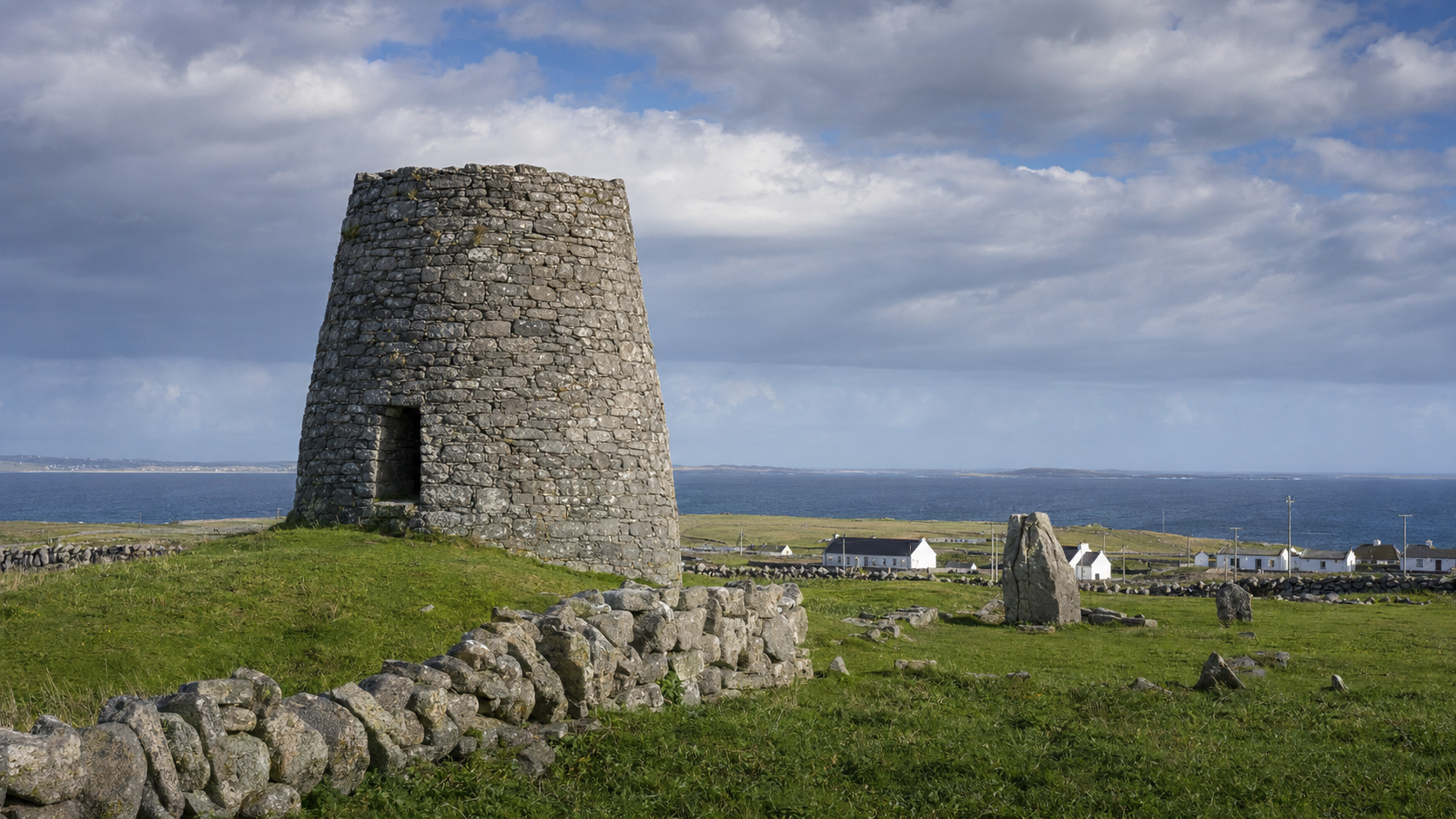
Set against the wild Atlantic landscape of Tory Island, the Monastic Site preserves the legacy of a religious community traditionally founded by Saint Colmcille in the sixth century. Its most prominent surviving feature is An Cloigtheach, the island’s granite bell tower and the only remaining Irish round tower in County Donegal. Standing nearly thirteen metres high, the tower once held Colmcille’s Bell and may also have served as a lookout over the surrounding sea. Together with the nearby Tau Cross, graveyard and scattered carved stones, it offers a powerful glimpse into Tory Island’s long Christian heritage.
-
The origins of Tory Island’s monastic settlement are traditionally traced to the sixth century, when Saint Colmcille, also known as Columba, established a religious community on the island. Its remote position off the Donegal coast offered the isolation sought by early Irish monks, while still placing the monastery along important Atlantic sea routes. Over the centuries, the community became an influential part of life on Tory, serving as a place of worship, learning and refuge.
The most substantial surviving structure is An Cloigtheach, meaning “the bell house.” Although the monastery dates from the sixth century, the precise age of the tower is uncertain, and it may have been constructed as late as the twelfth century. Built from rounded granite stones gathered from Tory’s beaches, it originally contained three internal floors. Its principal purpose was to hold the monastery’s bell, although its height and commanding position may also have allowed it to serve as a lookout over the surrounding Atlantic.
The monastery continued to influence island life throughout the medieval period but was plundered and destroyed by English forces in 1595. The tower survived, although lightning damaged it during the late eighteenth century. Clog Cholm Cille, the bell traditionally associated with Saint Colmcille, was removed from the tower following the damage and later disappeared during the nineteenth century. Today, the roofless tower stands alongside the Tau Cross, graveyard and other carved stones as evidence of more than a thousand years of Christian history on Tory Island.
-
In The Donegal Cipher, the trail of an ancient cipher leads George, Áine, Jazz and Irene across the waters to Tory Island. Their discoveries suggest that the island’s early Christian monastery once served a purpose beyond worship. According to the decoded records, its monks protected fugitives, preserved important documents and concealed treasures belonging to the O’Donnell clan as English control tightened across Ulster.
Guided past the Bell Tower and the ruined chapel by Brother Míchéal, the group searches within the old monastic enclosure. Beneath a weathered stone slab, they uncover a hidden chamber containing a reliquary, encoded manuscripts and evidence connecting Áine’s family to the island’s buried history. The real monastic remains provide the setting, while the concealed chamber and its contents are fictional elements created for the novel.
DONEGAL CASTLE: Stronghold of the O’Donnells
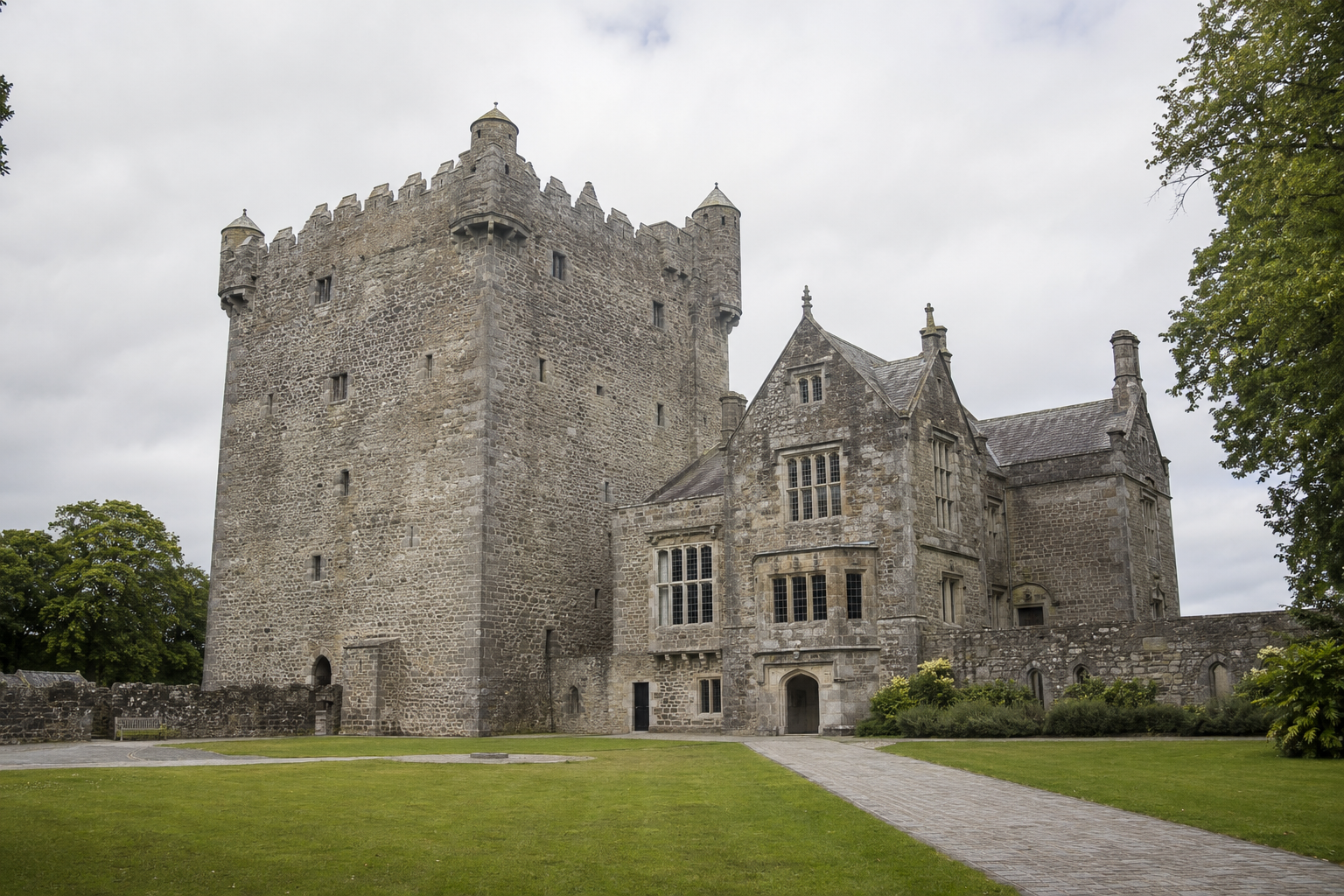
Standing beside the River Eske in the heart of Donegal Town, Donegal Castle was once the principal stronghold of the powerful O’Donnell clan, rulers of the Gaelic kingdom of Tír Chonaill. Built in the fifteenth century by Hugh Roe O’Donnell I, the imposing tower house later became closely associated with his descendant, the celebrated chieftain Red Hugh O’Donnell. With its medieval keep, later Jacobean additions and commanding riverside position, the restored castle offers a striking reminder of Donegal’s Gaelic past and the struggle to resist English expansion in Ulster.
-
Donegal Castle was built during the fifteenth century as the principal stronghold of the O’Donnell dynasty, rulers of the Gaelic kingdom of Tír Chonaill. Its construction is generally attributed to Hugh Roe O’Donnell I, who founded the nearby Franciscan friary in 1474. Positioned beside the River Eske, the castle combined a defensive tower house with a fortified enclosure known as a bawn. From here, the O’Donnell chieftains governed a territory that encompassed much of present-day County Donegal.
The castle is most closely associated with Hugh Roe O’Donnell, better known as Red Hugh, who became chief of the clan in 1592. Alongside Hugh O’Neill of Tyrone, he led Gaelic resistance to English expansion during the Nine Years’ War. Following the defeat of the Irish alliance at the Battle of Kinsale in 1601, Red Hugh travelled to Spain seeking military assistance. Tradition holds that he ordered Donegal Castle to be burned before his departure so that it could not be used by English forces.
English captain Sir Basil Brooke later received the property during the Plantation of Ulster. Between approximately 1611 and 1616, he repaired the medieval tower and added the adjoining Jacobean manor house, introducing large windows, decorative stonework and an elaborately carved fireplace. The result is the unusual building seen today, combining a Gaelic tower house with the architecture of the English Plantation.
The Brooke family left the castle during the seventeenth century, and the complex gradually deteriorated. It eventually passed into state care and underwent extensive restoration by the Office of Public Works during the 1990s. Today, Donegal Castle preserves evidence of two very different periods in Irish history: the final centuries of independent Gaelic rule and the political transformation that followed the Plantation of Ulster.
-
In The Donegal Cipher, Donegal Castle stands as the historic seat of the O’Donnell clan and a symbol of the Gaelic power they once held across Tír Chonaill. The novel’s prologue returns to 1607, after Rory O’Donnell, Earl of Tyrconnell, has fled Ireland during the Flight of the Earls. With the clan’s leadership fractured and English control tightening, Rory’s cousin and trusted captain, Domhnall, is charged with protecting what remains of the O’Donnell legacy.
That legacy includes a carefully guarded chest bearing Celtic carvings and protective iron bands. Removed in secrecy and concealed before it can fall into enemy hands, its story becomes entwined with the ancient cipher discovered centuries later following Colm O’Neill’s death. Although much of the modern investigation unfolds elsewhere, Donegal Castle provides the historical foundation for the mystery, connecting George, Áine and their companions to the final days of O’Donnell rule and the secrets the clan fought to preserve.
KNOCKNAREA: The Mountain of Queen Maeve
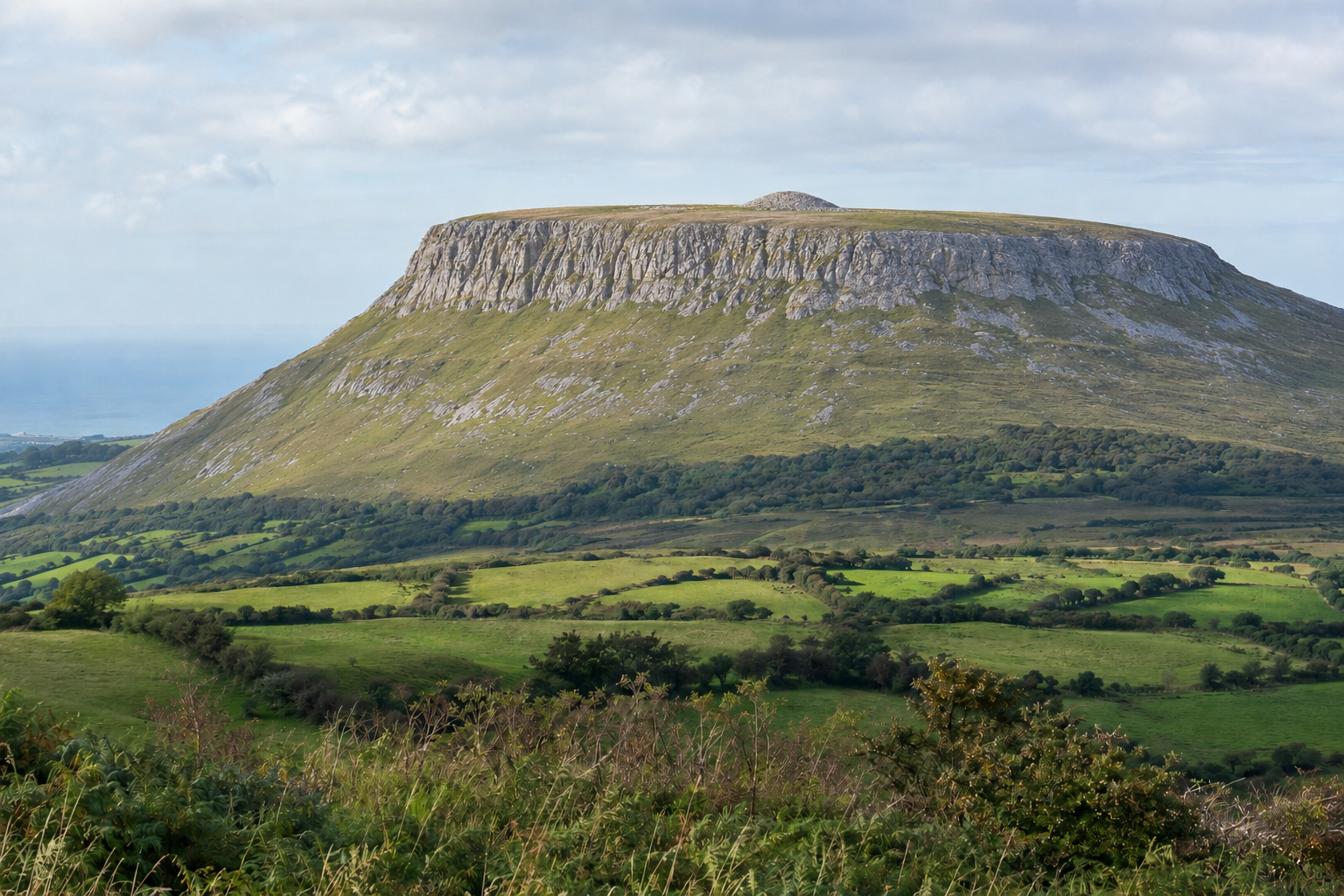
Rising above the Sligo coastline, Knocknarea is one of Ireland’s most distinctive prehistoric landscapes. At its summit stands the enormous stone monument known as Queen Maeve’s Cairn, traditionally believed to mark the burial place of the legendary warrior queen of Connacht. Archaeological evidence suggests the cairn was constructed during the Neolithic period, thousands of years before the stories of Maeve were recorded. Surrounded by smaller tombs and overlooking the ancient cemetery at Carrowmore, Knocknarea brings together archaeology, mythology and the dramatic natural beauty of County Sligo.
-
Knocknarea formed part of an important ceremonial landscape on the Cúil Irra Peninsula during the Neolithic period. Beginning in the fourth millennium BC, communities constructed numerous passage tombs across the surrounding countryside, including those at nearby Carrowmore. The mountain’s prominent position above the Atlantic coast made it a natural focal point within this extensive landscape of burial places, settlements and ritual monuments.
Its best-known monument is the enormous summit cairn called Miosgán Meadhbha, or Queen Maeve’s Cairn. Believed to have been constructed around 3000 BC, it measures approximately 55 metres across and 10 metres high. Archaeologists believe it probably covers a passage tomb, but the cairn has never been excavated. Its original builders and the identity of anyone buried within it therefore remain unknown.
Archaeological investigations have revealed that activity on Knocknarea extended far beyond the great cairn. The mountain contains several smaller passage tombs, the foundations of approximately fifteen circular houses and an extensive system of prehistoric banks stretching for roughly 2.5 kilometres. Evidence of stone-tool production has also been found, suggesting that people were living, working and gathering on the mountain around 3350 BC. Knocknarea was therefore not simply a burial site, but an active centre within the lives and beliefs of Neolithic communities.
The association with Queen Maeve, the legendary warrior queen of Connacht, developed much later. Tradition claims that Maeve was buried standing upright inside the summit cairn, facing north toward her enemies in Ulster. Archaeology cannot confirm this story because the monument predates the legendary queen by thousands of years. Nevertheless, the legend has become inseparable from Knocknarea, joining mythology with one of Ireland’s most remarkable prehistoric landscapes.
-
In The Donegal Cipher, Knocknarea is among the ancient places that held deep importance for Colm O’Neill. To Colm, sites such as Knocknarea, Mullaghmore and Ballure Glen were more than archaeological monuments. They represented Ireland’s history before colonization and division, preserving a connection to the people, beliefs and traditions that shaped the country long before its modern borders were drawn.
Queen Maeve’s Cairn is referenced again when George, Áine, Jazz and Shuggy investigate a concealed structure on the Isle of Man. Jazz uses Knocknarea as an example of how prehistoric monuments can acquire new stories and meanings over successive generations. This idea of layered history, where Neolithic sites become associated with later rulers, clans and legends, lies at the heart of the novel’s mystery and the O’Donnell legacy the group is attempting to uncover.
CREEVYKEEL: Sligo’s Great Court Tomb
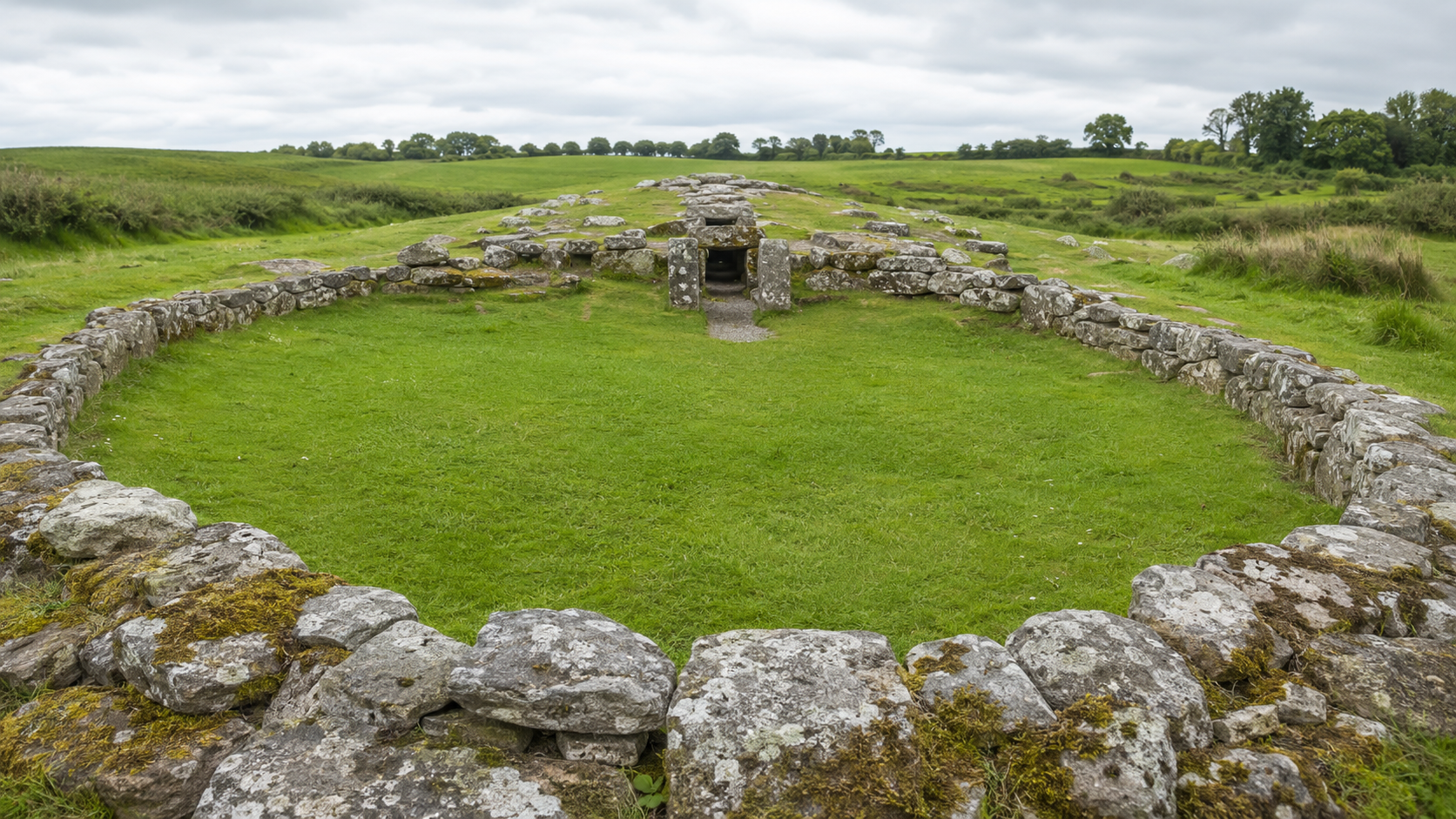
Set amid the rugged landscape of County Sligo, Creevykeel Court Tomb is one of Ireland’s finest and best-preserved examples of a Neolithic court tomb. Built around 3500 BC, the monument features a large oval entrance court leading into a gallery of stone burial chambers, where the cremated remains of members of the community were placed. Archaeological evidence shows that the site remained important for thousands of years, with later communities returning to reuse it for burials, ceremonies and metalworking. Today, its exposed stones offer a remarkable glimpse into the beliefs and rituals of Ireland’s earliest farming societies.
-
Creevykeel Court Tomb was constructed during the Neolithic period, probably around 3500 BC, by one of Ireland’s earliest farming communities. The monument originally consisted of a long, trapezoidal cairn measuring more than 50 metres in length. Within it, a passage led into a large oval court where members of the community may have gathered for ceremonies connected with burial, remembrance and ancestor worship.
At the western side of the court, an imposing stone entrance opened into a roofed burial gallery divided into two chambers. Small deposits of cremated remains were placed inside, accompanied by objects including polished stone axe heads, pottery, flint tools, an arrowhead and quartz crystals. Three additional chambers were built into the cairn, suggesting that the monument was altered and expanded as it continued to be used.
Creevykeel remained significant long after its original builders had disappeared. During the early medieval period, part of the court and burial gallery was adapted for everyday work. Archaeologists discovered hearths, animal bones, iron slag and the remains of a kiln, indicating that people used the ancient monument for cooking, grain drying and ironworking. This later activity demonstrates how prehistoric sites were repeatedly reinterpreted by succeeding generations.
The tomb was scientifically excavated in 1935 by the Fourth Harvard Archaeological Expedition, led by Hugh O’Neill Hencken. During the excavation, the cairn material was removed to expose the monument’s internal structure and then replaced, producing much of the organized appearance visitors see today. Creevykeel is now protected as a National Monument and remains one of Ireland’s finest surviving examples of a Neolithic court tomb.
-
In The Donegal Cipher, Creevykeel Court Tomb provides an important archaeological comparison when George, Áine, Jazz and Irene investigate the newly uncovered dolmen on the Mullaghmore headland. Jazz points out that most of the region’s prehistoric tombs, including Creevykeel, were constructed farther inland. This makes the fictional Mullaghmore monument’s exposed coastal position particularly unusual.
The characters do not visit Creevykeel itself. Instead, the real Neolithic tomb helps them recognize that something about the Mullaghmore discovery does not fit the established archaeological pattern. Their suspicions deepen when Áine reveals that carvings on the newly discovered monument match symbols found in her father’s manuscript, transforming an archaeological curiosity into an important clue in the mystery.
CARROWMORE MEGALITHIC CEMETERY: Ireland’s Ancient City of Tombs
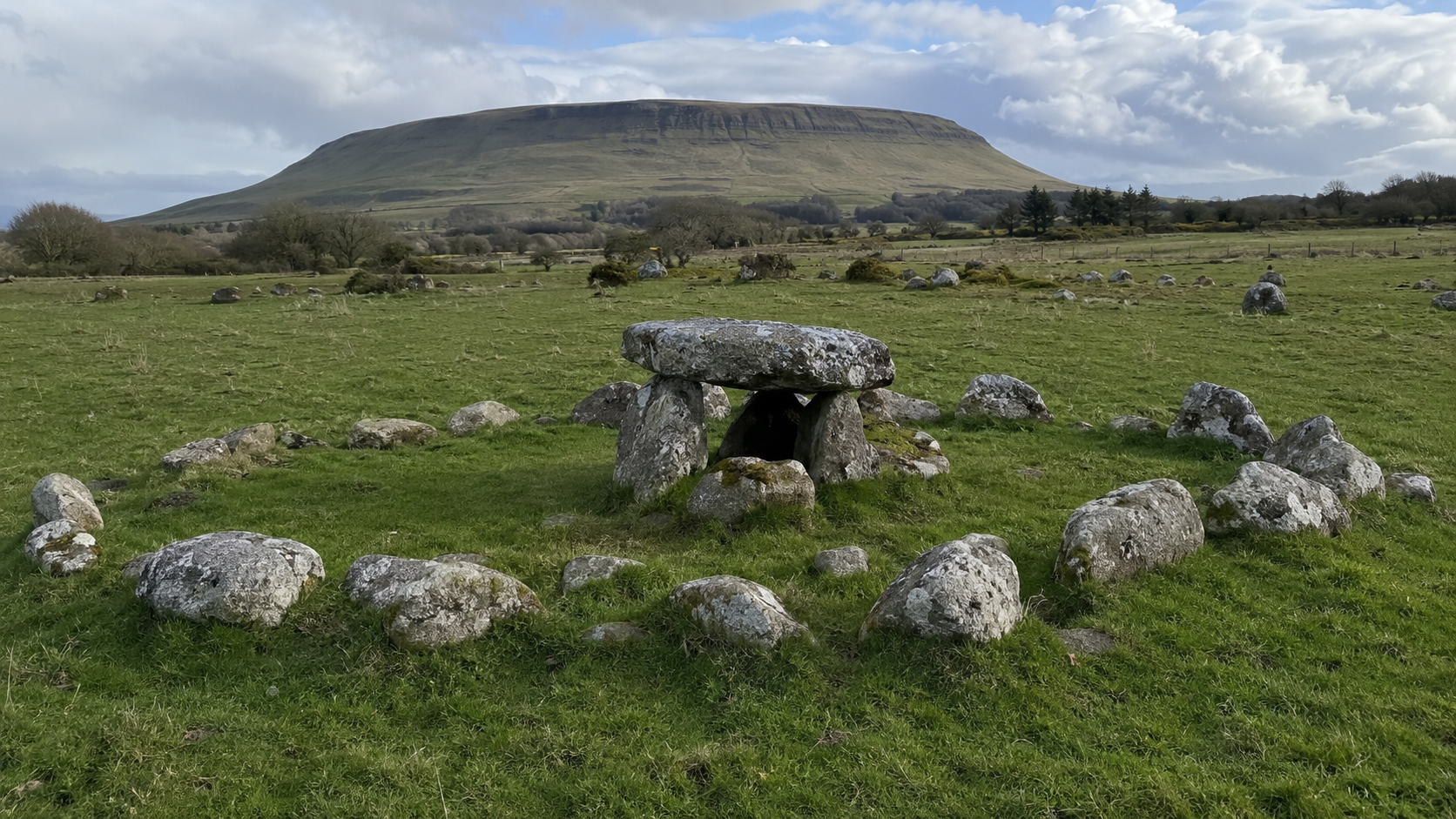
Set beneath the imposing silhouette of Knocknarea in County Sligo, Carrowmore is one of Ireland’s oldest and largest collections of Neolithic tombs. More than thirty monuments survive across the landscape, many consisting of a small stone burial chamber surrounded by a circle of boulders. Constructed almost 6,000 years ago, the cemetery reflects the rituals and beliefs of Ireland’s earliest farming communities. With the great cairn of Listoghil at its centre, Carrowmore forms the heart of an extraordinary prehistoric landscape that connects the living, the dead and the surrounding mountains.
-
Carrowmore Megalithic Cemetery was created by Neolithic communities during the fourth millennium BC, almost 6,000 years ago. Located at the centre of the Cúil Irra Peninsula, it formed part of a much larger ceremonial landscape that included the monuments on Knocknarea, Cairns Hill and the surrounding mountains. Archaeologists believe that more than sixty tombs may once have stood at Carrowmore, although just over thirty survive today.
Most of the monuments have a distinctive design: a small central burial chamber built from upright stones and surrounded by a broad circle of boulders. Unlike the enormous covered passage tombs found at Newgrange, many of Carrowmore’s smaller chambers may originally have remained visible or were covered only by low cairns. Cremated human remains were placed inside, sometimes accompanied by objects such as stone tools, pottery and decorative pins. Several tombs were reused over many generations, suggesting that Carrowmore remained an important gathering and burial place for centuries.
At the centre of the cemetery stands Listoghil, also known as Tomb 51. Constructed around 3500 BC, it differs from the surrounding monuments because its rectangular chamber was enclosed within a large stone cairn. Archaeological investigation found the remains of several people inside, while the monument’s orientation connects it with the Ballygawley Mountains to the southeast. Many of Carrowmore’s smaller tombs appear to face toward Listoghil, indicating that it became the ceremonial heart of the cemetery.
Over the centuries, many monuments were damaged by farming, road construction, quarrying and early antiquarian digging. Modern archaeological research began during the nineteenth century, followed by extensive Swedish-led excavations between 1977 and 1998. These investigations helped establish Carrowmore’s extraordinary age and importance. Today, it is protected as a National Monument and forms the centre of the proposed Passage Tomb Landscape of County Sligo, currently included on Ireland’s tentative list for UNESCO World Heritage status.
-
In The Donegal Cipher, Carrowmore is referenced when George, Áine, Jazz, Irene and Shuggy investigate a collapsed structure in Ballure Glen on the Isle of Man. Jazz compares the hollow beneath the stones to the smaller cairns found at Carrowmore and Carrowkeel in County Sligo, using those real prehistoric monuments to help interpret what the group has uncovered.
The characters do not visit Carrowmore itself. Instead, the ancient cemetery provides a genuine archaeological comparison for the novel’s fictional discovery. Its inclusion reinforces one of the book’s central ideas: that similar monuments and traditions can connect places across the Irish Sea, while later generations add new histories, legends and secrets to structures created thousands of years earlier.
CASHTAL YN ARD: The Castle of the Heights
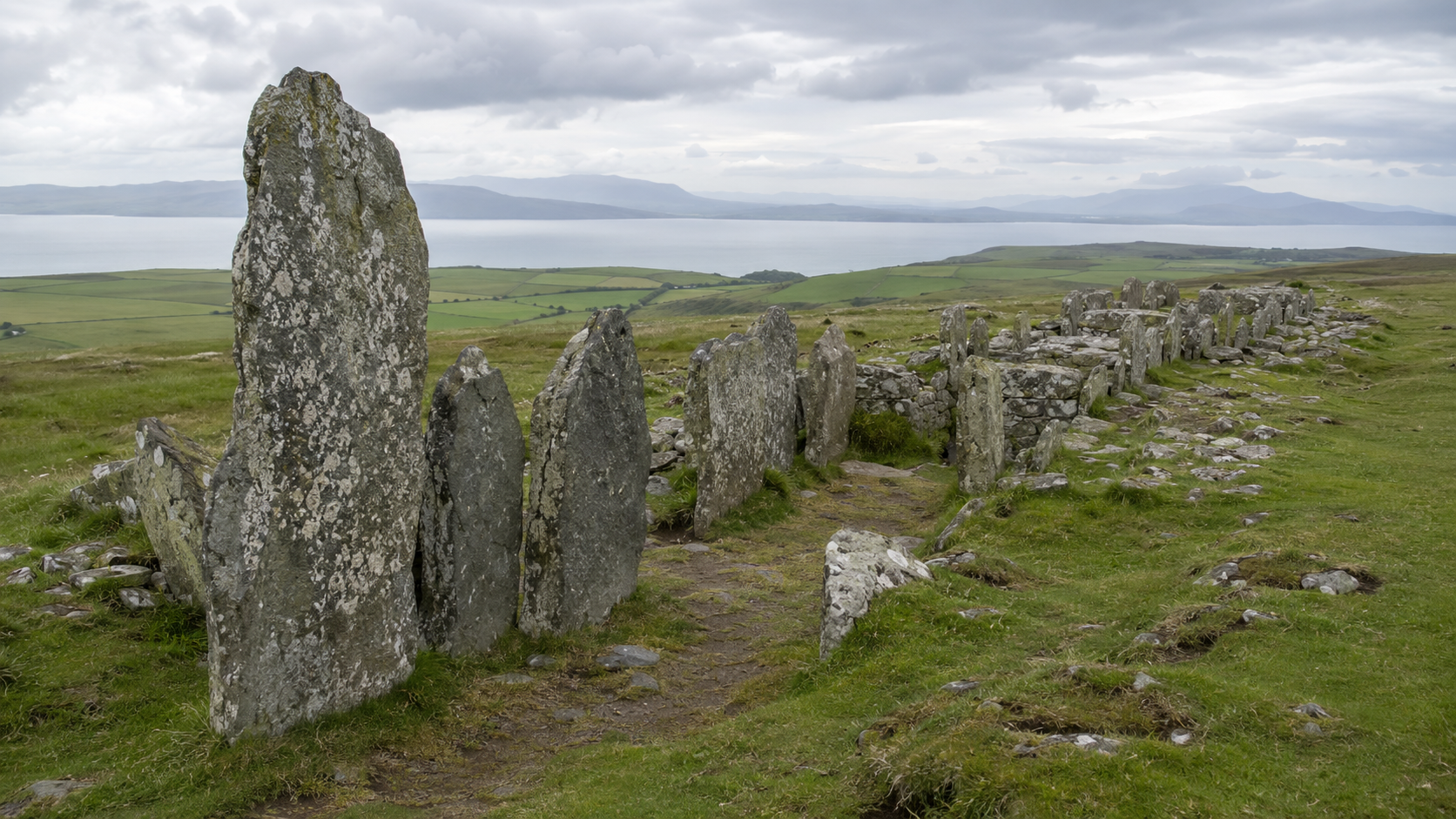
Set high above Maughold on the Isle of Man, Cashtal yn Ard is one of the island’s most impressive prehistoric monuments. Its Manx name means “Castle of the Height,” an appropriate title for a Neolithic chambered tomb commanding sweeping views across the surrounding countryside and the Irish Sea. Built around 3000 BC, the monument originally consisted of a long stone cairn enclosing a series of burial chambers approached through a dramatic open forecourt. Although much of the cairn has disappeared, its massive standing stones preserve the outline of a ceremonial site created by the island’s earliest farming communities.
-
Cashtal yn Ard was constructed around 3000 BC by one of the Isle of Man’s earliest farming communities. Its elevated position above Maughold gave the monument commanding views across the surrounding countryside and the Irish Sea. This prominent setting was probably deliberate, allowing the tomb to serve as both a burial place and a visible landmark for the community that built it.
The monument originally consisted of a long, trapezoidal cairn enclosed by upright kerbstones. A large, west-facing forecourt led through two imposing portal stones into a gallery divided into five burial chambers. The forecourt may have been used for ceremonies honouring the dead, while human remains and burial offerings were placed within the stone chambers. The entire structure would originally have been covered by a great mass of stone, leaving only the ceremonial entrance exposed.
Evidence suggests the location was important even before the tomb was constructed. Archaeologists identified three earlier features beneath or beside the cairn: a small stone-lined burial known as a cist, a deposit of burnt stones and an unusually large standing stone. These discoveries indicate that the hilltop may already have been used for ritual or burial activity before Cashtal yn Ard took its final form.
Much of the cairn was stripped away over later centuries, with stones reportedly removed for nearby buildings and field walls. Scientific excavations conducted in 1932 and 1933 revealed the monument’s original plan and confirmed its Neolithic date. Although its covering cairn has largely disappeared, the surviving forecourt, portal stones and five chambers make Cashtal yn Ard one of the finest surviving Neolithic long cairns in the British Isles.
-
In The Donegal Cipher, Cashtal yn Ard is referenced when George, Áine, Jazz and Shuggy investigate the concealed structure in Ballure Glen. Jazz compares their discovery to the Manx tomb, explaining how a seemingly unremarkable hollow in the landscape can conceal a much older, multi-chambered monument.
The characters do not visit Cashtal yn Ard itself. Instead, it provides an archaeological comparison that helps them interpret the fictional Ballure Glen site. Its long history also supports one of the novel’s central themes: ancient monuments were sometimes reused by later clans, allowing Neolithic burial places to become entwined with medieval claims, legends and family legacies.
REAL PLACES. ANCIENT QUESTIONS
THE BEGINNING OF THE ADVENTURE